
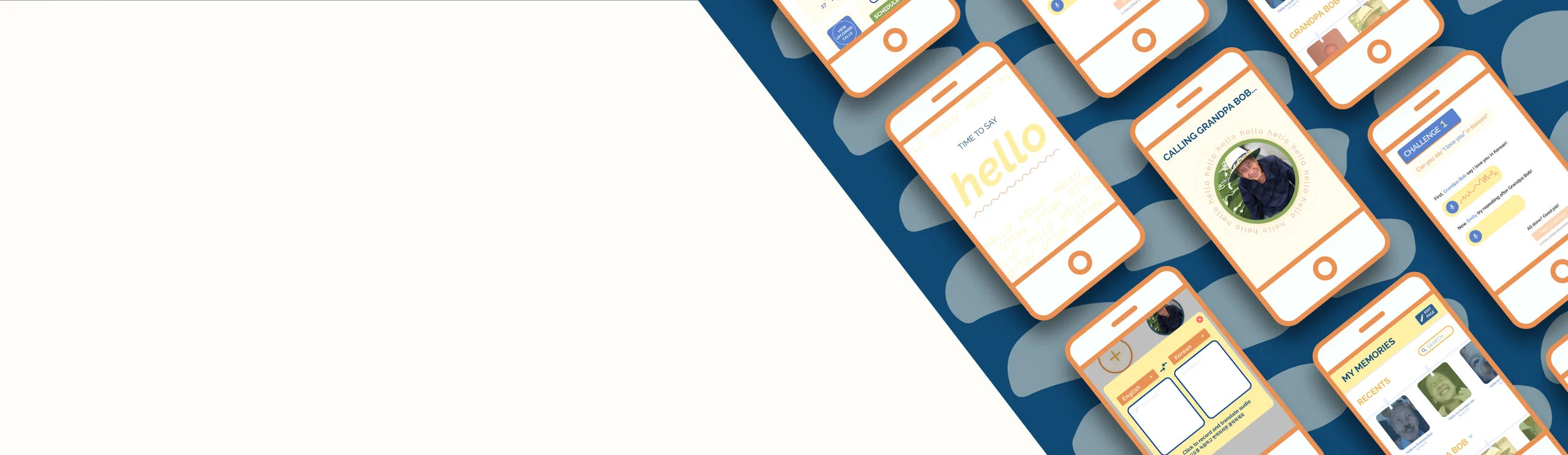
Hello
Rethinking language and distance barriers between
Grandparents and Grandchildren.
-
Time
2 Weeks
-
Team
2 Product Designers
-
Role
Research
UX
-
Deliverables
Design System
Figma Prototype
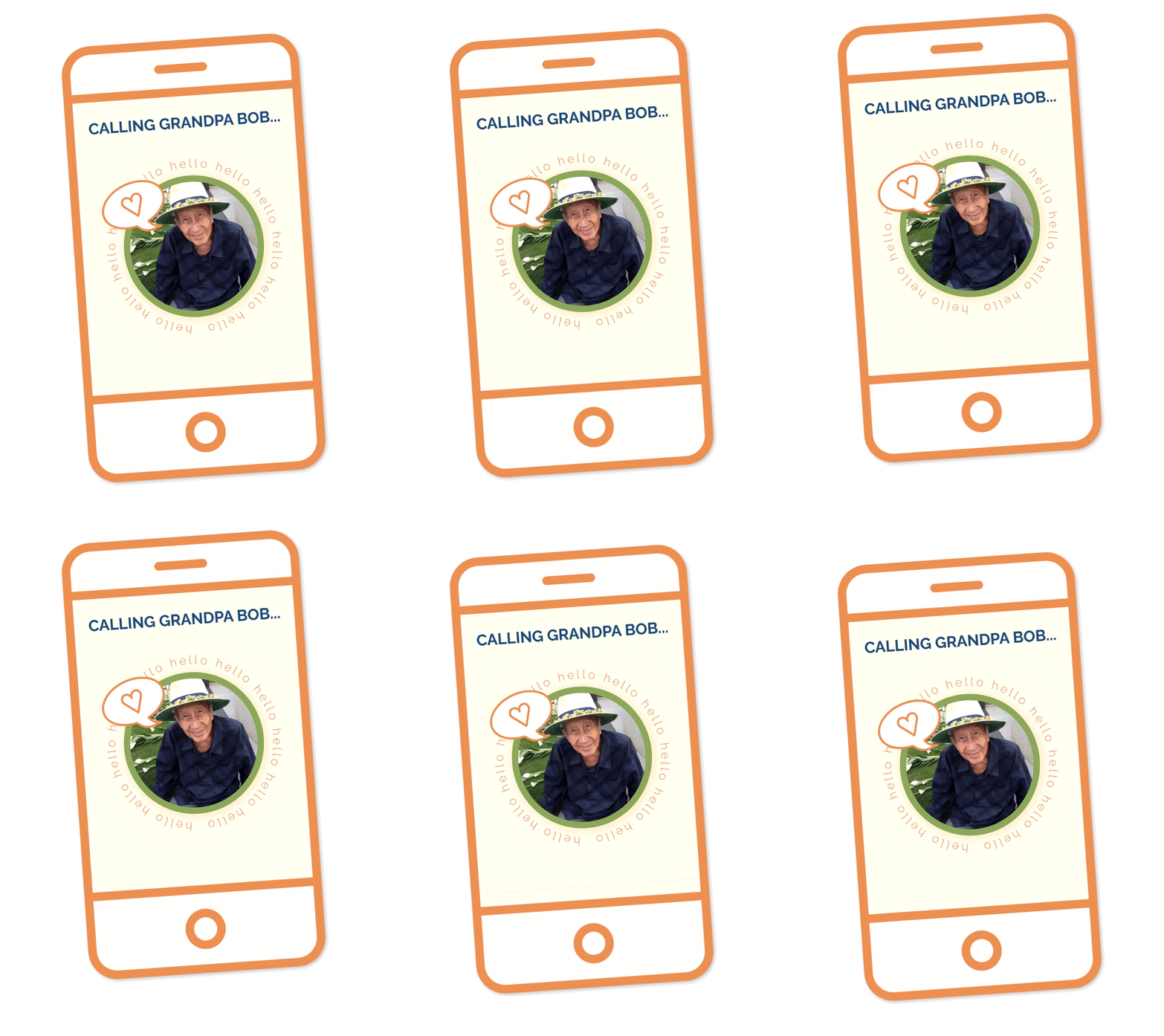
We designed Hello —
a playful mobile app that transforms saying hi to Grandma and Grandpa from something young children guiltily dread into an exciting, joyful experience to look forward to.
This was a capstone project completed at Dartmouth College in response to the prompt of loneliness and isolation. My co-designer and I used the design thinking process to conduct primary and secondary research, iterate ideas, and prototype. This case study highlights my research analysis, wireframes, and interactive designs.
BACKGROUND
Developmental research indicates that the number of caring adults there are in a child’s life is a predictor of future success and happiness. Additionally, the presence of a Grandchild in a Grandparent’s life can be preventative against dementia.
43%
of Grandparents in the United States live more than 200 miles away from their Grandchildren.
Statista
61%
of Grandparents in the United States do not feel like they see their Grandchildren enough.
Statista
PROBLEM
Language + Distance
When Grandma and Grandpa live far away and don’t speak the same language as their Grandchildren, how are they to build strong, long lasting connections with their young loved ones? In fact, often when Grandma and Grandpa call, Grandchildren can be reluctant to “say hi” because they feel shy or awkward speaking to their Grandparents through language and geographical barriers.
OPPORTUNITY
How might we reframe the act of saying “hello” to a child’s Grandparents as something to look forward to rather than get over with?
Grandchildren
Kids need attention, patience, and love in order to develop a sense of identity, belonging, and self-worth. They are fun-loving and playful, but can also be shy and impatient. Grandparents
Grandparents who don’t get to see their Grandchildren can feel like they’re missing milestone after milestone, as well as meaningful everyday activities such as reading their Grandchildren bedtime stories. Moreover, Grandparents often have more time and patience than parents to show children love and support without needing to be disciplinarians. SOLUTION
Our Answer? Hello.
A video-calling, activity based mobile app with collaborative gameplay designed to ease the tension of language and distance barriers between grandparents and grandchildren.
What does it mean to say Hello?
Gameplay + Screen Sharing.
Kids get bored. Quickly.Each call on Hello includes a set of playful, collaborative challenges for Grandparents and their Grandchildren to complete together on a dual-controlled, shared screen. Challenges include a mix of language-learning tasks as well as light-hearted, silly activities. Challenge screens also include a translation feature to ensure everybody is on the same page.Translate Anything, Anytime.
Sure, Mom and Dad can translate for Grandparents and Grandchildren—but it’s not quite the same, is it? Hello’s handy translation tool provides a speedy, convenient method for users to translate both text and audio inputs into their loved one’s language. Our tool is designed so that translated content can be shared on screen during a call via both audio and text. Relive memories.
We all know that Grandma and Grandpa are obsessed with looking through old photos. Hello enables Grandparents to relive each call with their loved ones through an automated ‘Memories’ feature which compiles photos, videos, and voice recordings from their previous calls. What People Are Saying
Young adults believe they would have had a closer relationship with their Grandparents growing up had they had Hello.
Hello has been described as unique, fun, engaging, warm, and intuitive.

Hello
Tackling familial barriers through learning and play.
PROCESS
RESEARCH
Background
When thinking about loneliness during the COVID-19 era, my co-designer and I wanted to target the age demographic whose loneliness was impacted at the largest magnitude: elderly populations. We both grew up with Grandparents who lived abroad and only spoke another language that we weren’t fluent in, and so we wondered if anybody else had a similar experience. We were shocked by the amount of people who resonated with our inter-generational struggle. We were compelled by the story we kept hearing in interviews over and over again: feeling remorseful over not being closer to a Grandparent, but struggling to meaningfully communicate with them during our younger years.
RESEARCH
User Interviews
In order to better understand the relationship between multilingual, long-distance Grandparents and Grandchildren, we interviewed two main groups:
Grandparents and Grandchildren with language and distance barriers
Parents with children and parents with language and distance barriers
We crafted our questions in order to more deeply explore different experiences between Grandparents and Grandchildren including any pain points or limitations in these challenging relationships. We fed our insights into empathy maps for each interview we conducted, and utilized Affinity Mapping in order to identify key themes in our insights. 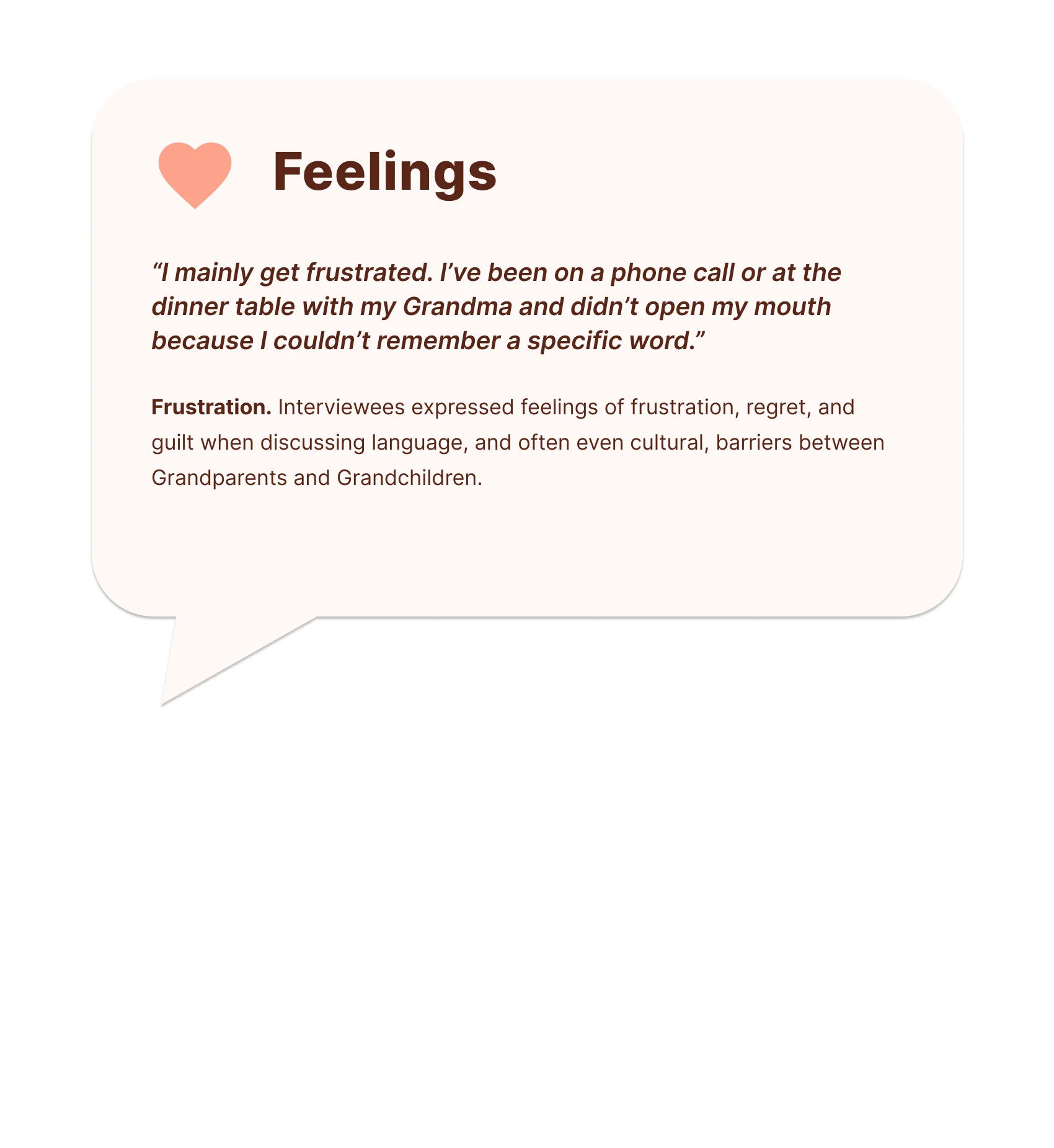
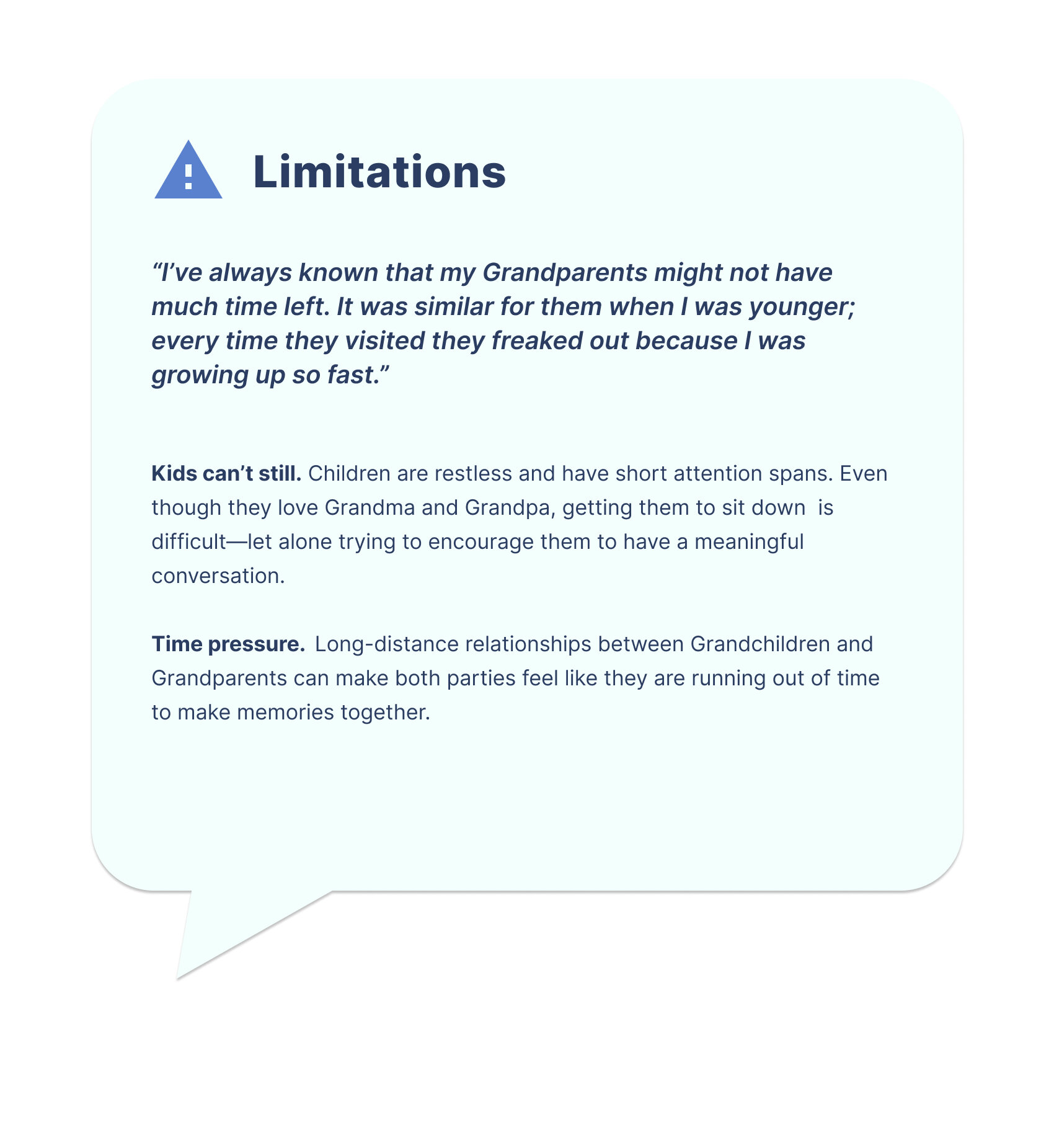
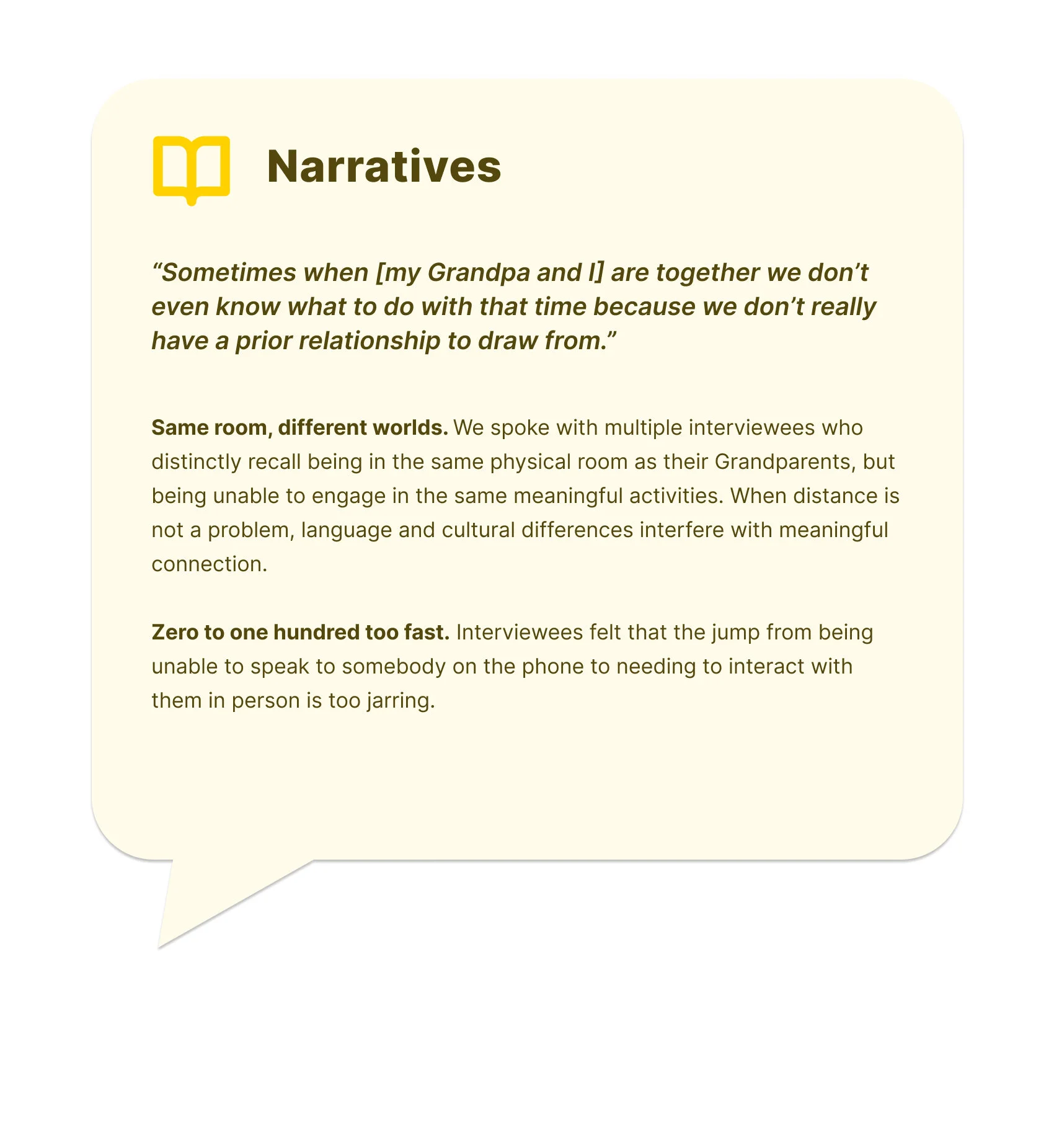
DEFINE
Personas
From our user interviews, we created two main personas to help represent the needs of a larger target group of users. DEFINE
Empathy Maps, Journey Maps, Needs
User research and personas helped us to form empathy maps, enabling us to gain deeper insight into the layered experiences of our specific audience.We then developed journey maps to identify each step in the Grandchild-Grandparent phone calling process and highlighted opportunities with potential for rethinking and improvement. We synthesized our qualitative data and findings into an array of needs in order to help us define key insights and pain points. Pain Point #1:
The current medium for communication fails to consider how children connect.
Pain Point #2:
Language barriers prevent Grandparents and Grandchildren from being able to imagine and construct a closer relationship.
DEFINE
POV Statement
Young children need a fun and engaging method of connecting with their Grandparents.
IDEATE
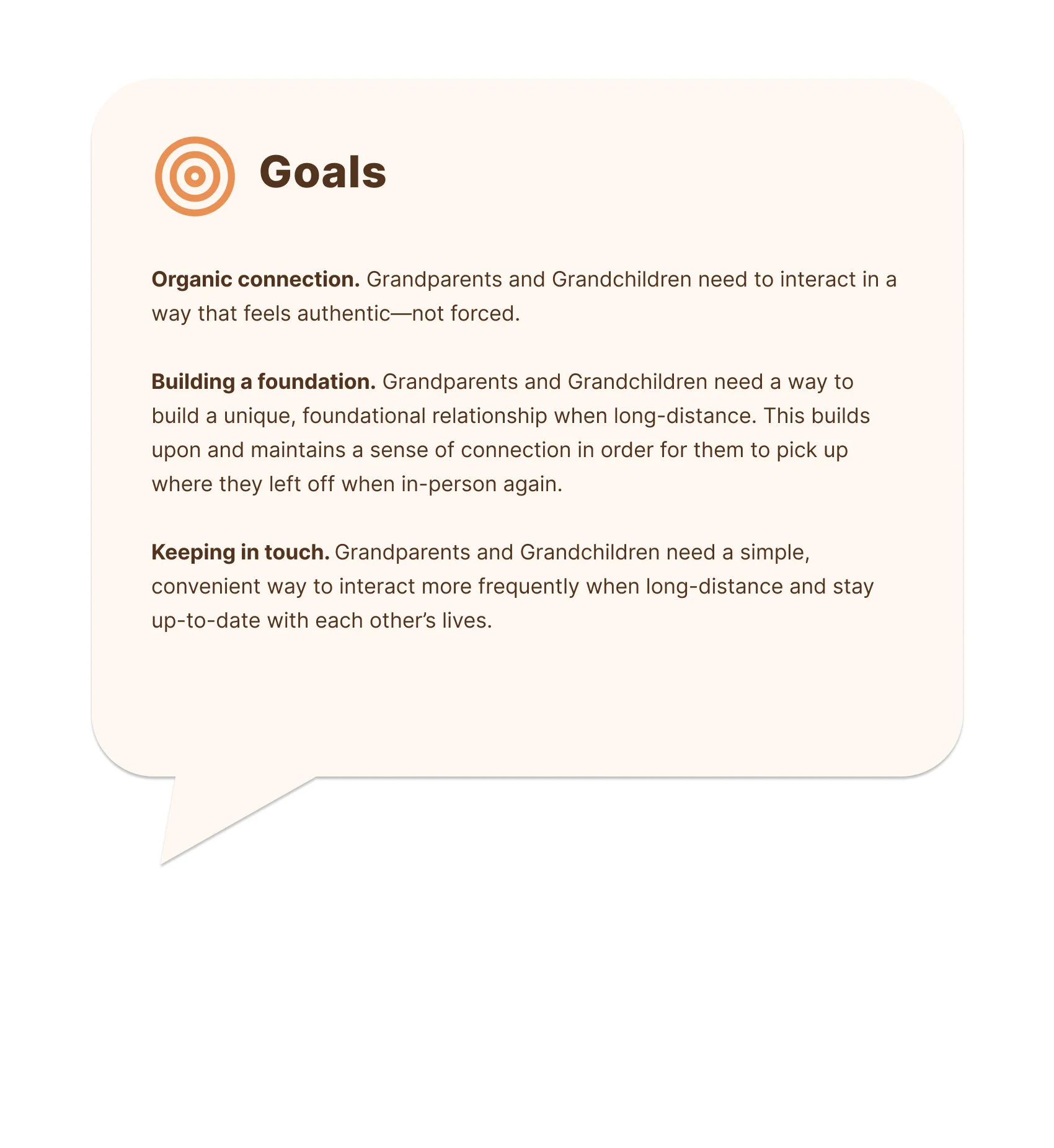
Goals
Simple
The layout of the solution must be intuitive and user-friendly for both young children and potentially technologically challenged Grandparents.
Fun
The premise of the solution must spark delight in both Grandparents and Grandchildren in order to facilitate a meaningful, growth-oriented relationship.
IDEATE
Brainstorm
Our interviews made me realize how much the COVID-19 pandemic had pushed families to find different digital solutions to compensate for not being able to be in the same physical space. I drew upon a variety of approaches including customized storybooks, postcards, and even gamified experiences for inspiration. Here are a few of the possible solutions I brainstormed utilizing the Crazy 8’s method. Features of functions that I wanted to include moving forward were highlighted in yellow. PROTOTYPE & TEST
Low Fidelity Wireframes
Wireframe Sketches
Given the tight time constraints for the project, I needed a way to quickly assess my ideas and synthesize them into a comprehensive digital solution. I drafted the first set of wireframe sketches for Hello (example below), then translated the wireframes into greyscale mockups in order to gain usability insights and explore a wider range of possibilities. I prioritized simplicity in my designs and focused on experimenting with screen layouts that would feel familiar from mobile apps users already use. Calling User Flow
Given the tight time constraints of this project, I wanted to ensure that I prioritized designing screens that were integral to the calling function of our user flow. I discovered that the main screens users needed to efficiently complete the calling process were (A) the contact screen, (B) the calling screen, (C) a basic challenge screen, and (D) a call scheduling screen. Memories Screen
I used Competitive Analysis of similar mobile apps and Multiple Variant Testing to help shape several iterations for each screen and to evaluate which screens were most intuitive for users. Displayed below are the different potential screens that were designed for Hello’s ‘Memories’ feature. Usability Findings revealed that Grandparents prefer layouts that remind them of holding and admiring physical photographs of their loved ones. Users preferred a rendition of option C because the clothesline design was reminiscent of family photos being lovingly stuck onto a fridge. PROTOTYPE & TEST
VISUAL DESIGN SYSTEM
Before moving on to high fidelity prototypes, we constructed a style guide in order to ensure our screens upheld our key usability findings. Colors
Hello’s primary colors were chosen to mimic the feeling of a playground so that using Hello would evoke feelings of safety, familiarity, and playfulness for the user. Secondary colors were selected in order to create balance for the vibrancy of our color palette, providing a muted foundational tones while still maintaining high contrast options for users of different ages. Typography
My co-designer and I used different variations of the bolded Raleway font because it’s large and blocky, making the words more accessible for both young and elderly users in both English and character-based languages (i.e., Korean). We also wanted a font that evokes the feeling of a board game or post card to help reinforce Hello’s family-friendly theme. PROTOTYPE & TEST
HIGH FIDELITY PROTOTYPE & USABILITY INSIGHTS
Our prototype is designed for the perspective of our Grandchild persona. Emily’s Mother asks to her to “go say hello to Grandpa Bob” and hands over her mobile device. Emily would usually be nervous, but today she has nothing to fear because Hello has her back. CALLING + CHALLENGES
Emily launches Hello, and is first taken to our Family Contacts screen where she selects Grandpa Bob. When Grandpa Bob picks up, they are taken to a standard Calling Screen where Emily can see both Grandpa’s and her own live video.
After Emily and Grandpa Bob have exchanged a few pleasantries, the pair proceed to their challenges.
The pair are taken to Challenge 1, a language-based task which teaches Emily to say “I love you” in Korean. Challenge 2 is a camera-based task where the pair take a silly picture together with a goofy filter. A call beyond this prototype might include up to five different challenges.
During challenges, screen sharing is activated. This means that both Emily and Grandpa Bob can see and interact with the same screen, while still seeing their live videos in the upper right corner.
USABILITY FINDINGS
Users expressed that the transition between the Family Contacts screen and the call recipient’s face was too abrupt. We added a friendly Dialing Screen to help make calls less intimidating.
TRANSLATION
Whether Grandpa Bob is visiting in-person or the pair are chatting on Hello, Emily can use Hello’s handy Translation Tool to help her share her life with Grandpa.
When Emily and Grandpa Bob are calling, the translation pop-up is included in screen sharing, allowing seamless integration into virtual conversations. This way, either user can input typed or spoken phrases, and both can see the translation.
Usability Findings
Hello’s initial prototype included a My Herd function that allowed users to collect coins and elephant avatars (our original Hello mascot was a family of elephants). However, users found this function confusing, and asked for more of the language translation features they loved.
SCHEDULING
Emily never needs to wonder when she will speak to Grandpa Bob with Hello’s scheduling tool.
Our Schedule A Call screen enables Emily, Grandpa Bob, and even parents to schedule calls with different Grandparents and Grandchildren through a calendar layout. Users can view upcoming calls with time zone differences accounted for.
Usability Findings
Our initial prototype’s scheduling feature utilized a scrolling selection layout rather than a calendar layout. Users expressed wanting a change in layout to help younger and older audiences visualize when and how often they would be able to speak to their loved ones.
MEMORIES
When Emily and Grandpa Bob miss each other, they can use Hello’s My Memories feature to relive their favorite virtual moments together.
My Memories includes a Search feature which allows users to quickly locate a specific memory. Users can explore their sorted Memory Library through recent calls, person, or through all past calls.
Usability Findings
Users loved being able to look back on cherished memories, but wanted an intuitive way to share these moments. In response, we added a Share feature enabling users to send voice recordings, videos, and pictures to friends and family.
REFLECT
TAKEAWAYS & NEXT STEPS
Growing up, I took seven years of Chinese language classes so that I might be able to have a stronger relationship with my Grandparents, who all spoke broken English. Hello was a special project to work on because, similar to many of the users interviewed, I always knew that language barriers would prevent my friendships with my Grandparents from reaching their full potential. Having a platform like Hello growing up would have taken away Chinese lessons as a requirement to simply be closer to those who loved me. I loved working on Hello because I don’t want children to feel like there are benchmarks that need to be met to receive and enjoy love. NEXT STEPS
Elderly accessibility concerns. While Hello was designed for both Grandparents and Grandchildren, our time constraints meant the majority of user testing included Grandchild testing groups. Moving forward, Hello demands further testing regarding text size, button size, and other accessibility concerns. Scheduling during calls. User testing indicated the need to be able to schedule the next call at the conclusion of a current call to increase call continuity. Hello beyond childhood. Hello’s challenges are currently designed for young Grandchild demographics. How can we make Hello more engaging for teenage and young adult age groups as well? Hello as a form of babysitting. Grandparents have lots of time on their hands and an abundance of love to give. How might we develop Hello so that Grandparents can babysit their Grandchildren for Parents from a distance? Thanks for reading! Still curious?

